
Trauma Therapy
“Trauma is not the event. It is the body’s response to the event.”
Peter Levine
Healing from Trauma – Gentle, Safe, and Empowering
You have lived through the traumatic event once — and that was more than enough.
In our sessions, we do not re-enter the trauma or replay what happened.
This is not exposure therapy.
Instead, we work gently.
We move slowly.
We build safety together.
Because the body remembers emotions, we invite it into the process with care.
Through mindful body awareness, gentle touch, or allowing incomplete defensive responses to naturally resolve, the nervous system can begin to release what it has been holding.
This work is not about pushing through trauma — it is about helping the body let go of what it no longer needs to carry, making space for ease, strength, and a renewed sense of aliveness.
Why to choose this approach?
When past experiences have been too intense or difficult to process, the nervous system can hold on to excess energy, leaving you feeling stuck, tense, or overwhelmed. In our sessions, we work gently to release this energy, allowing it to flow naturally and be redirected toward a greater sense of control, joy, and vitality in your life.
Clients often notice profound changes, including:
Freedom from intrusive thoughts and distressing memories
A noticeable reduction in internal tension
Lessening or disappearance of psychosomatic symptoms, such as aches, tics or overeating.
A renewed sense of energy and vitality
Feeling grounded, present, and connected to everyday life
Through this work, it becomes possible to let go of what the body has been holding onto and make space for ease, strength, and a deeper sense of well-being.

Methods and types of trauma I work with:
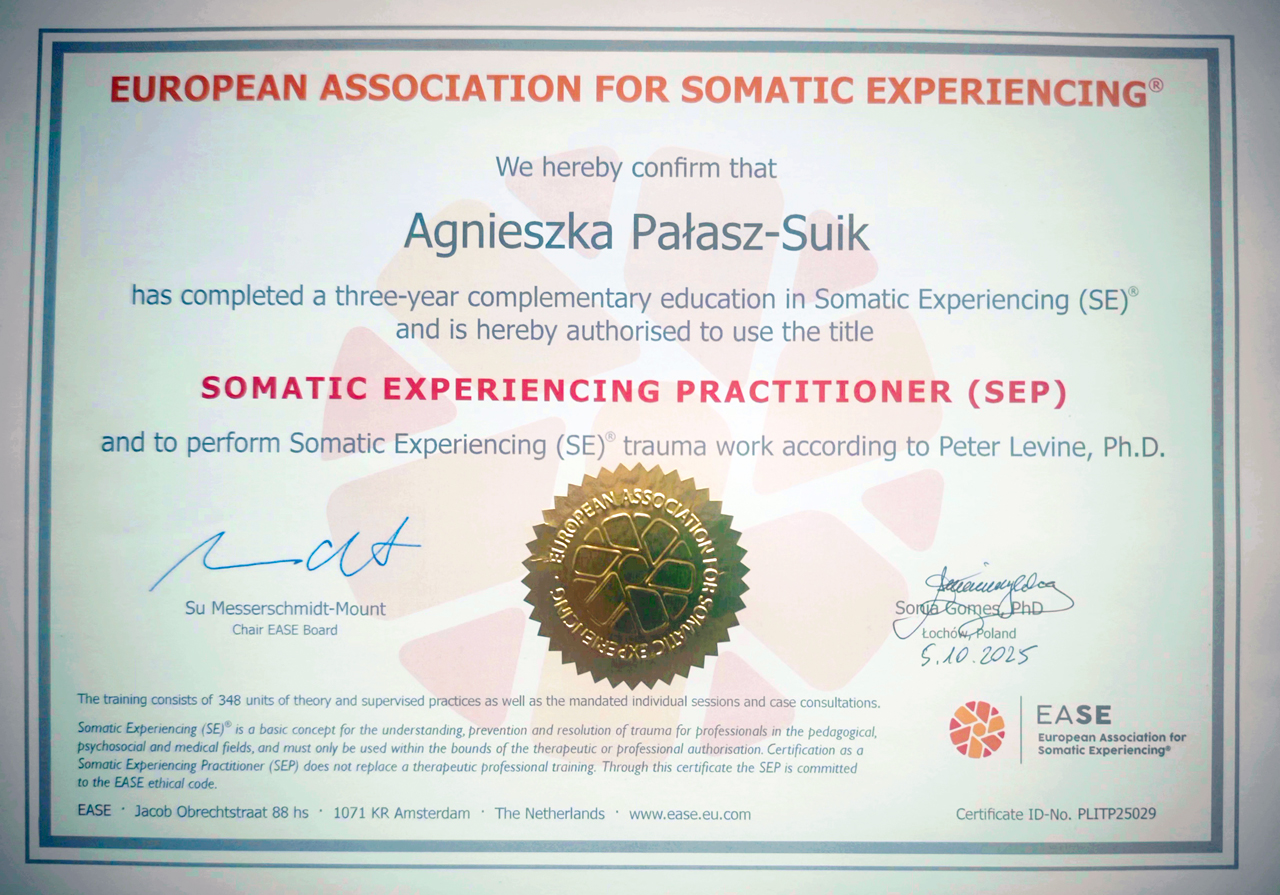
My trauma therapy practice draws on several approaches, which I tailor individually to each client. These include Peter Levine’s Somatic Experiencing®, elements of Stephen Porges’ Polyvagal Theory, Dr Raja Selvam’s Integral Somatic Psychology, and Solution-Focused Therapy.
Below you will find examples and types of trauma.
I have worked with many of them in my practice.
Complex Trauma

Complex trauma often arises from repeated or long-term experiences that place a heavy strain on the nervous system. This can include domestic violence, family addiction, emotional instability at home, or living with a disability.
These experiences can leave lasting effects, but with gentle, supportive work, it is possible to find safety, restore balance, and reconnect with your sense of self.

Developmental Trauma
Developmental trauma often stems from difficult experiences in childhood that have shaped how we relate to our emotions and the world around us. This can include things like losing a loved one at an early age, not having a caregiver who could fully understand and respond to your needs, or experiencing emotional and physical neglect.
These early experiences can leave a lasting mark, but through gentle, supportive therapy, it is possible to heal old wounds, develop emotional resilience, and reconnect with your true self.
Developmental trauma often arises from challenging early experiences that shape how our nervous system learns to respond to the world. Experiences such as the loss of a loved one in childhood, growing up without a caregiver who could consistently attune to and meet your needs, or enduring emotional or physical neglect can leave a deep imprint on the body and mind.
When our early environment did not feel safe or responsive, we may learn patterns of protection that once helped us survive but later limit our sense of ease and connection. With gentle, attuned therapeutic support, it is possible to begin restoring a sense of internal safety, gradually releasing old survival responses, and reconnecting with your authentic self.

Shock Trauma
Single-incident trauma results from exposure to an intense, one-off event that overwhelms a person’s capacity to cope and disrupts their sense of safety. Such events may include road traffic accidents, sexual assault, animal attacks, near-drowning, falls, choking episodes, fires, natural disasters or invasive medical procedures.
Although the event has ended, its effects may persist within the nervous system. This can manifest as hyperarousal, intrusive memories, flashbacks, avoidance behaviours or heightened anxiety. Through carefully paced and trauma-informed therapeutic work, it is possible to support nervous system regulation, process unresolved survival responses, and gradually restore a stable sense of safety, calm and agency.
Testimonials
Check out testimonials from my clients.
“Agnies is an incredible person—full of empathy, warmth, and inner calm. She provides a safe space where I can face my fears and work through the issues that matter most to me. Thanks to our work together, I have let go of many anxieties, reconnected with myself, gained clarity about what truly matters, and started enjoying life again.
The body-focused approach that Agnies offers has been a deeply healing experience for me, even helping to release tension-related pain. I am so grateful to have found her. The sessions with Agnieszka have provided me with immense support, and I honestly don’t know what I would have done without her.”
Natalia
“Agnies helped me through a major crisis. Not only was I able to overcome my difficulties, but I also learned, through her guidance, to be kinder to myself. With Agnies, I always felt understood, seen, and—most importantly—completely at ease. I learned how to treat myself better.
The work with Somatic Experiencing has brought significant changes to my life. I feel less tension and anxiety, and my previous feelings of paranoia have disappeared. I have learned to listen to my body’s signals and now have a healthier perception of myself. I am deeply grateful and truly recommend working with Agnieszka to anyone.”
Emilia
“I completed a six-month therapy with Agnieszka focusing on relationship issues, and I highly recommend her. She is a warm and trustworthy person who creates a comforting atmosphere during sessions, making it easy to open up and feel at ease.
I particularly appreciate her use of body-based and breath-focused techniques, which help to process and recognize emotions. I also valued being able to adjust the frequency of sessions to fit my schedule and needs. I have learned a lot that I am now putting into practice in my life, and I know that I can reach out to her again whenever I need support.”
Ela
“Aga is, above all, a very open and warm person, which made me feel safe with her very quickly. The knowledge and techniques she chose to help me work through my trauma took root in my body and allowed me to experience sensations and connections I had never felt before.
„I finally have full access to my emotions, and understanding and accepting them has brought me the peace and relief I had been longing for. I will always remain grateful to Aga for guiding me through this difficult process and for supporting me every step of the way.”
Magda
“Working with the body was a new experience for me. Through our sessions, I realized just how deeply thoughts, emotions, and the body are connected. I highly recommend it.”
Zuza
“Agnieszka is wonderful! Her sessions offered me support, understanding, and invaluable guidance.”
Katarzyna
“Meeting Agnies came at a very meaningful time in my life (though I didn’t realize it at first). From our very first session, I felt that she was the person I wanted to work with—I sensed the energy she brings and knew it was the right fit.
At the beginning, the sessions were not easy for me, as I didn’t know how to open up or fully trust. But thanks to the warm and supportive atmosphere she creates, I soon felt safe, cared for—knowing I was not alone, which was incredibly important for me.
Through working with Agnies, I have learned so much about myself, my emotions, and my feelings. I have gotten to know myself more deeply and continue to do so, discovering the joy of being present with my experiences. Most of all, I am grateful that I now look forward to every session—I no longer avoid what I feel or what has happened. I genuinely enjoy the process. Thank you so much, Agnieszka.”
Ira
„Agnieszka listens with care, sensitivity, and deep understanding.She doesn’t jump to conclusions or impose theories. Instead, she helps you arrive at concrete solutions yourself and practice handling difficult situations, all within a supportive and safe atmosphere.”
Joanna
“Agnies is attentive, empathetic, and insightful. With her, I always felt cared for, understood, and completely safe. I highly recommend working with her.”
Małgosia
“I completed a six-month therapy with Agnieszka focusing on relationship issues, and I highly recommend her. She is a warm and trustworthy person who creates a comforting atmosphere in each session, making it easier to open up and feel at ease.
I particularly appreciate her use of body-oriented techniques, which help to process and recognize emotions. I also valued being able to adjust the frequency of sessions to fit my schedule and needs. I have learned a lot that I am now putting into practice in my life, and I know I can reach out to her again whenever I need support.”